dalsengagitoksangma15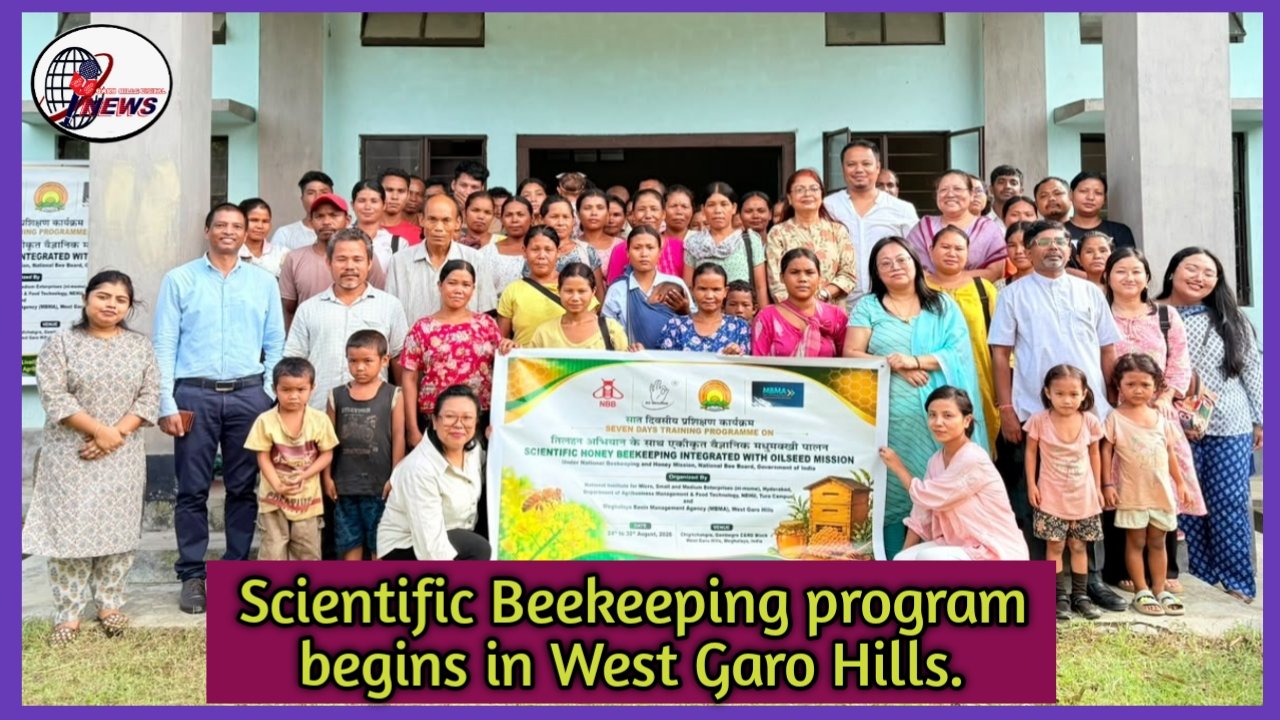
Tura, August 25, 2026: A seven-day training programme on scientific honey beekeeping, aimed at strengthening sustainable agricultural practices and improving livelihood opportunities for farmers, commenced on Monday at Chigitchakgre Bee Village under Gambegre Community and Rural Development (C&RD) Block in West Garo Hills district.
Titled “Scientific Honey Beekeeping Integrated with Oilseed Mission,” the programme will continue until August 30 and is being conducted under the National Beekeeping and Honey Mission. The initiative is jointly organised by the National Institute for Micro, Small and Medium Enterprises and the Department of Agribusiness Management and Food Technology, North-Eastern Hill University (NEHU), Tura Campus, in collaboration with the Meghalaya Basin Management Agency (MBMA).
The inaugural programme drew the participation of more than 100 villagers, along with academicians and research scholars from NEHU’s Tura Campus. While the inaugural session witnessed broad community participation, the intensive practical and hands-on components of the training will be undertaken by 50 selected participants.
Addressing the gathering, Prof. Deepak Bhagat, Head of the Department of Agribusiness Management and Food Technology, NEHU, Tura Campus, underlined the importance of collaboration between academic institutions and government agencies in converting traditional beekeeping practices into commercially viable and sustainable agribusiness activities.
Shri V. Valentine Hembrom, DPM, MBMA/MeghaLAMP, West Garo Hills, highlighted the economic potential of linking scientific apiculture with the Oilseed Mission. He said such integration could help strengthen rural livelihoods, enhance farmers’ economic resilience and facilitate access to wider markets for locally produced agricultural commodities.
The significance of beekeeping from an agricultural perspective was further elaborated by Dr. Joyoshree Mahanta, Chief Technical Officer (Plant Pathology), ICAR-KVK, Sangsanggre. She explained the critical role played by bees in pollination and noted that maintaining healthy and productive bee colonies can contribute significantly to improving the yield of oilseed crops.
Shri Armand Ch. Momin, MCS, Block Development Officer of Gambegre C&RD Block, encouraged the participants to make full use of the training and adopt improved beekeeping techniques. He stressed that the acquisition of modern skills and knowledge could contribute not only to individual household incomes but also to broader socio-economic development across the block.
Representing NEHU, Prof. F. K. Marak, Campus-in-Charge, NEHU, Tura Campus, reaffirmed the university’s commitment to extending scientific knowledge and technological innovation beyond academic institutions and into rural communities.
The inaugural session concluded with a vote of thanks delivered by Dr. Sheena Haorongbam, Assistant Professor, NEHU, and coordinator of the programme. She acknowledged the contributions of the participating institutions, government agencies, resource persons and the local community, while expressing confidence that the week-long programme would provide participants with practical knowledge and skills relevant to modern honey production.
Over the next seven days, the selected participants are expected to receive intensive exposure to scientific beekeeping practices, with the programme seeking to promote apiculture as a sustainable livelihood activity while simultaneously supporting pollination and productivity in oilseed cultivation.