dalsengagitoksangma15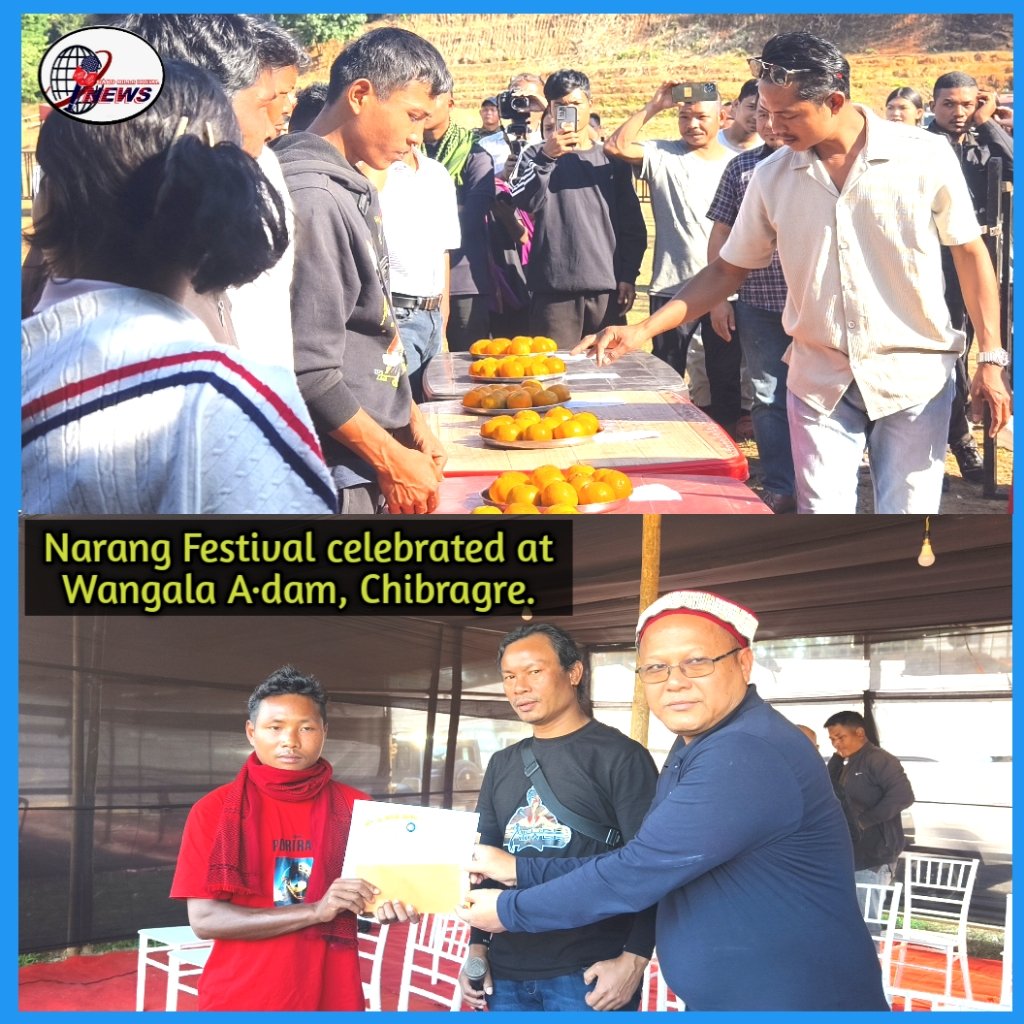
@ghdnews.in@
Tura, Dec 19, 2025:
The Hundred Drums Wangala Festival Committee (HDWFC) on Thursday organized the Narang Festival at the Garo Heritage Village, Wangala A’dam, Chibragre, celebrating the rich agricultural traditions of the Garo Hills with a special focus on Komila (orange), one of the region’s most widely cultivated and valued crops.
The festival served as a vibrant platform to highlight the superior quality and organic diversity of oranges native to the Garo Hills, while simultaneously reviving community interest in horticulture and sustainable farming practices. Marking the first time the committee dedicated an event to a single crop, the Narang Festival successfully blended cultural celebration, farmer participation, and market-oriented awareness.
A series of lively competitions formed the centerpiece of the event, including the Chi-batgipa (Sweetest Orange) Competition, Rongmabatgipa (Largest Orange) Competition, and Komila Cha Susaani (Orange Eating) Competition. Shri Ezekiel A. Sangma emerged as the champion of the Orange Eating Competition, securing the first prize of Rs. 5,000, followed by Shri Lintubar A. Sangma who won Rs. 3,000 and Shri Pijeng R. Marak who received Rs. 2,000. In the Sweetest Orange and Largest Orange categories, Shri Tengrang A. Sangma and Shri Preman D. Sangma were declared winners, receiving Rs. 3,000 each. Notably, the Largest Orange title was clinched by an impressive 12.3 cm orange brought from Gondengre village.
Speaking on the occasion, Shri Ronald Rikman Ch. Sangma, Chairman of the 100 Drums Wangala Festival Committee, expressed his enthusiasm over the successful organization of the inaugural Narang Festival. He stated that the committee’s decision to focus on oranges was aimed at highlighting the economic and cultural importance of the fruit, while also encouraging farmers to take pride in their produce. He added that future editions of the festival may include other fruits such as Atol Memang Narang and Pamela.
Sangma further emphasized that the core objective of the festival was to provide farmers with a platform to showcase their produce, connect with better markets, and promote organic farming practices. He noted that organically grown fruits from the Garo Hills have significant demand in national and international markets, and initiatives like the Narang Festival can play a vital role in strengthening farmers’ livelihoods.
The Narang Festival concluded with renewed optimism among farmers and organizers alike, reaffirming the commitment to promote horticulture, organic cultivation, and the agricultural identity of the Garo Hills through community-driven initiatives.