dalsengagitoksangma15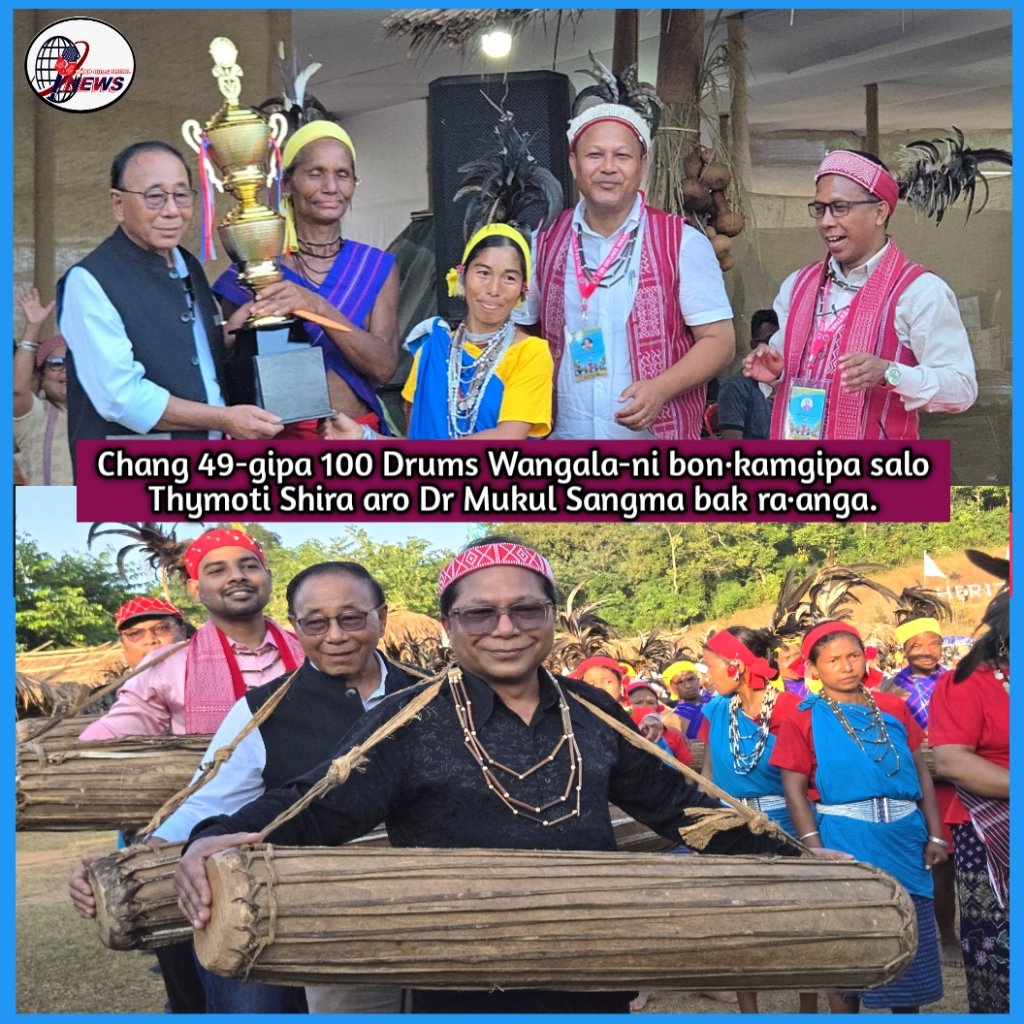
@ghdnews.in@
Tura, Nov 8, 2025:
The 49th Hundred Drums Wangala Festival 2025 concluded today at Garo Heritage Village and Wangala A·dam at Chibragre, West Garo Hills, with grandeur and enthusiasm as thousands gathered to celebrate the rhythmic heartbeat of Garo culture. The final day of the festival was marked by colourful performances, traditional ceremonies, and inspiring words from leaders who underscored the importance of cultural preservation and identity.
The Chief Guest for the closing ceremony, Timothy D. Shira, Minister of Agriculture & Farmers’ Welfare, Fisheries and Tourism, Government of Meghalaya. The Guests of Honour included Brening A. Sangma, Minister of Border Areas Development, Home (Civil Defence & Home Guards) and Excise, and Sanbor Shullai, Minister of Animal Husbandry & Veterinary, Arts & Culture, Legal Metrology, and Printing & Stationery. Also present was V.S. Kumaran, Assistant Director, Ministry of Tourism, Government of India, along with other dignitaries and officials.
The programme began with the presentation of mementoes to the Chief Guest and dignitaries, followed by the rendition of the Dimdim Dimchong Dachichong, the Wangala theme song. In his welcome address, Chairman of the Hundred Drums Wangala Festival Committee (HDWFC), Ronald Rikman Ch. Sangma, expressed gratitude to all supporters and highlighted the festival’s vital role in promoting tourism, unity, and cultural awareness among the younger generation.
In his address, Chief Guest Timothy D. Shira extended his thanks to the Almighty for the wonderful day and reflected on the journey of Meghalaya’s cultural revival. He reminisced about the days when Meghalaya was still part of Assam, noting that back then, there were no dedicated initiatives to preserve and promote the rich cultural identity of the people.
He recounted that in his younger days, people from hilly regions also observed the Wangala ceremony, but due to the absence of roads and the dangers of wild animals, he was unable to witness it first hand. With the formation of Meghalaya as a separate state, he said, “Our leaders thought deeply about safeguarding our culture, rituals, and traditions and in 1976, under the leadership of our first Chief Minister, Captain Williamson A. Sangma, the first Hundred Drums Wangala Festival was organised here in Asanang.” He expressed deep gratitude to the late Captain Williamson Sangma and Sendfort K. Marak, then Minister of Arts and Culture, for their vision and contribution in institutionalising the Wangala Festival, which now proudly celebrates its 49th edition.
Shira reflected on how over the years, the Wangala Festival has grown beyond the traditional and religious boundaries, finding its place in mainstream cultural events across the Garo Hills-even among Christian populations and in the plains. “Today, Wangala has become a part of our collective cultural expression,” he said, adding that the festival’s rhythms and dances are now seen at various programmes across the region.
Sharing personal anecdotes, the Chief Guest recalled his early experiences with the festival. In 2005, after being elected as MLA from Resubelpara, he had organised a Wangala Festival there where he awarded prizes to the best performing contingent. “Later,” he narrated humorously, “someone complained that the winning team did not deserve the award because their drumbeats were off rhythm. At that time, I did not know much about Wangala and decided to observe and learn it myself.”
He went on to share how a few years later, when a Garo Minister from Bangladesh visited Dalu, he witnessed a captivating Wangala performance by local villagers that deeply impressed him. Similarly, during a visit to Byrnihat in 2009 as Chief Guest, he noticed that the performers were not following the proper steps and rhythms of Wangala. “I took the opportunity to advise them to bring someone who truly knows the dance and culture to teach them,” he added, underlining the importance of performing Wangala correctly to preserve its authenticity.
Expressing his happiness at the way the festival has evolved, Shira said, “I am proud to see our culture and traditions being showcased widely and appreciated by people from all over the country and even abroad. We must continue to promote and refine this festival, making it bigger and better each year.”
Touching upon tourism, he highlighted the government’s ongoing efforts to develop tourist destinations and cultural heritage spots across the region. He also suggested that evening cultural shows could be regularly hosted at the Garo Heritage Village in Asanang so that visiting tourists can experience the spirit of Wangala even beyond the main festival days.
The day’s highlights included the Chachat So∙a Ceremony, symbolising thanksgiving to the Sun-God Misi Saljong, followed by an energetic dance competition among ten contingents and the grand performance of the Rhythm of Hundred Drums Wangala, which drew loud applause from the crowd.
The festival concluded with the prize distribution ceremony where in in today’s Wangala competition was won by Chidaogre contingent (First), while Gondenggre contingent was awarded 1st Runner Up (Second) and Sadolbra got 2nd Runner Up (3rd). Later the Wangala competition was followed by a music festival and cultural concert by well know artist from outside the state and other noted local artists as well.
The 49th Hundred Drums Wangala Festival once again stood as a proud testament to the unity, identity, and cultural vibrancy of the Garo community, inspiring all to look forward to next year’s Golden Jubilee celebration with even greater anticipation.
Dr. Mukul Sangma, Leader of the Opposition (LO) of Meghalaya Legislative Assembly was also joined in the final day of 49th 100 Drums Wangala Festival, 2025 in the afternoon.